Home / Motorisation & automation / River Club
A four-metre entertainment wing with six chains hanging off it is a chore nobody keeps up. Here, motorisation is the default specification, not the upgrade.
Free field guide — Four Houses on One Acre: what the highveld sun does to a house here, elevation by elevation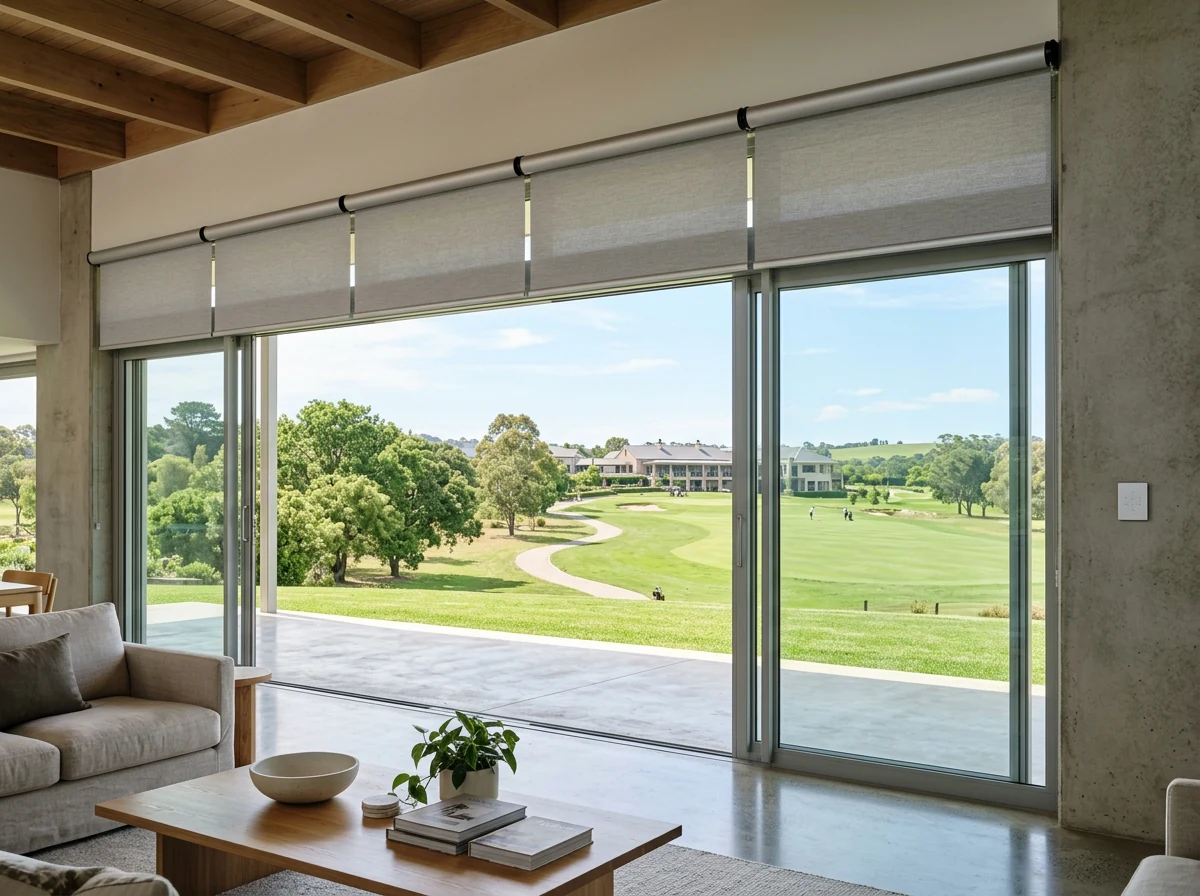
River Club's entertainment wings are built wide because the fairway view is the point of the room, and that same width is exactly what makes a hand chain the wrong tool. A four-metre roller blind carries real weight in its fabric and tube, and where the glass is split into several blinds side by side to manage that width, a homeowner is looking at working down a row of five or six separate chains before guests arrive for sundowners. It's the kind of daily friction that ends with the blinds simply staying up, glare and all.
Motorisation solves the mechanical problem first — a slim tube motor takes the weight instead of a chain wearing against it — and then solves the real one, which is grouping. Several blinds along one wide wall get wired onto a single remote channel, or a scene on a wall switch, so the whole wing closes with one press rather than six separate trips. That's not a convenience feature bolted on afterwards; on a River Club-scale wing it's the difference between a system that actually gets used at five o'clock and one that doesn't.
Where the wing carries stair or double-volume glass — common in the larger entertaining-led layouts here — motorised tilt and lift is often the only workable answer regardless of width, simply because nobody can reach a wand or chain up there safely. We treat that glass as motorised by default and build the rest of the room's control scheme around it, rather than fitting one remote for the high window and leaving everything else on a chain that doesn't match.
Wind sensors matter more here than the width argument alone would suggest. Gauteng's worst supercell storms cluster in October and November and peak in the mid-afternoon — almost exactly the hours an exterior zip screen or awning on a River Club patio is likely to be out for shade or entertaining. A motorised exterior product with a wind sensor retracts itself the moment gusts build, whether or not anyone is home — and on a golf estate, "home" often means out on the course itself when the weather turns, not in the house watching for it.
The practical decision at the measure is where the power comes from. In an existing River Club house, wired motors mean finding a cable route to the head of each opening, which is a walk-around with a torch rather than a guess over the phone; battery tube motors sidestep that entirely and just need charging a few times a year. New-build and renovation wings are simpler — the electrician runs the cable while the wall is still open, and the motor never needs charging at all.
Next step
Tell us what you're dealing with. One of our expert consultants will contact you shortly to arrange a free in-home measure with samples — no obligation.
Book my free measure Bryanston Blinds