Home / Roller & day-night blinds / River Club
No building or boundary tree stands between the entertainment wing and the fairway — which is exactly why the fabric choice on this glass is different from anywhere else in Bryanston.
Free field guide — Four Houses on One Acre: what the highveld sun does to a house here, elevation by elevation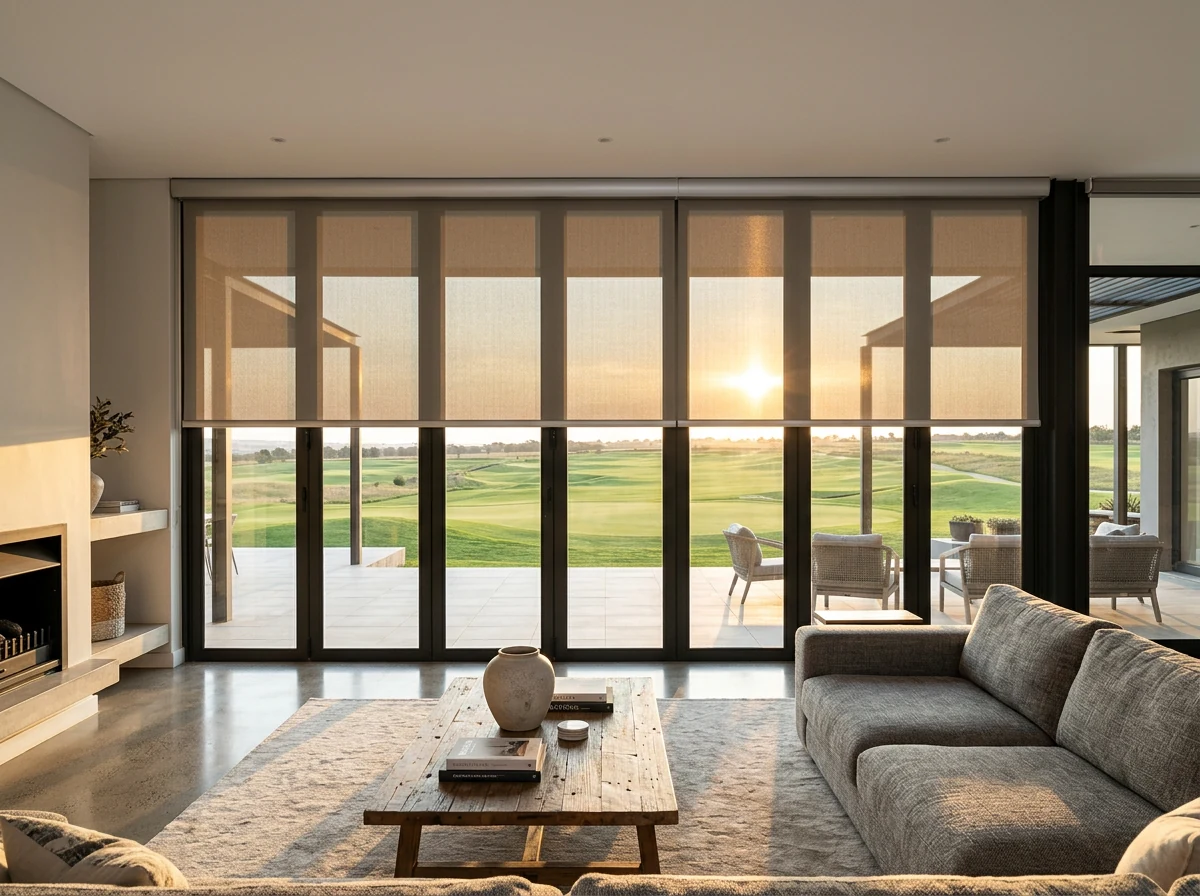
A River Club living room is built around the view, and the view is the problem. In most Bryanston gardens a boundary wall, a hedge or a neighbour's roofline breaks up the sky before the sun gets truly low. Here there is nothing between the glass and open ground — the fairway runs on uninterrupted, so the low morning and late-afternoon sun arrives across a wider arc of the day than it would against a walled suburban garden, and it arrives almost horizontal. An overhang, however deep, cannot block a ray that's travelling sideways rather than down.
That is exactly the case a sunscreen roller blind is built for: one flat, open-weave fabric sheet on a tube, no folds and no gathering, hung close to the glass so it intercepts the ray before it lands on the couch. The decision that actually matters on this wall is the weave's openness percentage, and River Club is the suburb where it matters most. A tighter 3% weave cuts more glare and more heat, but it also dims the fairway itself — on a wing built specifically to show off that view, a fabric that flattens it defeats the point of the room. A more open 8–10% weave keeps the grass green and the flag visible but does less work in the worst hour. We walk this trade-off room by room at the measure rather than defaulting to one number for the whole house, because a study facing the ninth green wants a different answer from a dining room facing the clubhouse.
Width is the second local problem. Entertainment wings on a golf frontage tend to run wide — four metres of glass is ordinary, not exceptional — and a single roller fabric has a practical width limit before the tube starts to sag under its own weight. Past that point we either split the glass into two or three blinds side by side, which puts a bracket line down the view, or move to a heavier reinforced tube that can carry one continuous sheet. Which one suits a given wall depends on where the mullions already sit in the frame, which is a measure-day decision, not a brochure one.
Night is the trade-off nobody thinks about until they're standing in the room after dark. Sunscreen fabric works by letting light through in both directions — useful by day, a problem once the lounge lights are on and the fairway is dark, because from outside the glass now reads as lit rather than shaded. Golf frontages are more open than a walled garden, so more of the course, and anyone on it, can see straight back in. Where that matters — a lounge used for evening entertaining rather than a study that empties at dusk — we pair the sunscreen with a blockout on the same double bracket, so one chain gives daytime glare control and the other gives night-time privacy without swapping blinds.
The other factor specific to unshaded golf glass is simply how much sun it gets. At Johannesburg's altitude, ultraviolet exposure runs meaningfully higher than at the coast, and a wall with no tree or building shading any part of the day takes the full dose from open to close. We specify a higher-grade coated fabric on this glass rather than the lighter decorative weaves that suit a partly shaded window elsewhere in the same house — the fabric that looks identical in the showroom ages very differently once it's carrying a full River Club summer.
Next step
Tell us what you're dealing with. One of our expert consultants will contact you shortly to arrange a free in-home measure with samples — no obligation.
Book my free measure Bryanston Blinds