Home / Roller shutters / Sunninghill
Contemporary Sunninghill elevations are built with almost no overhang — which means the shading has to happen at the glass itself, not above it.
Free field guide — Four Houses on One Acre: what the highveld sun does to a house here, elevation by elevation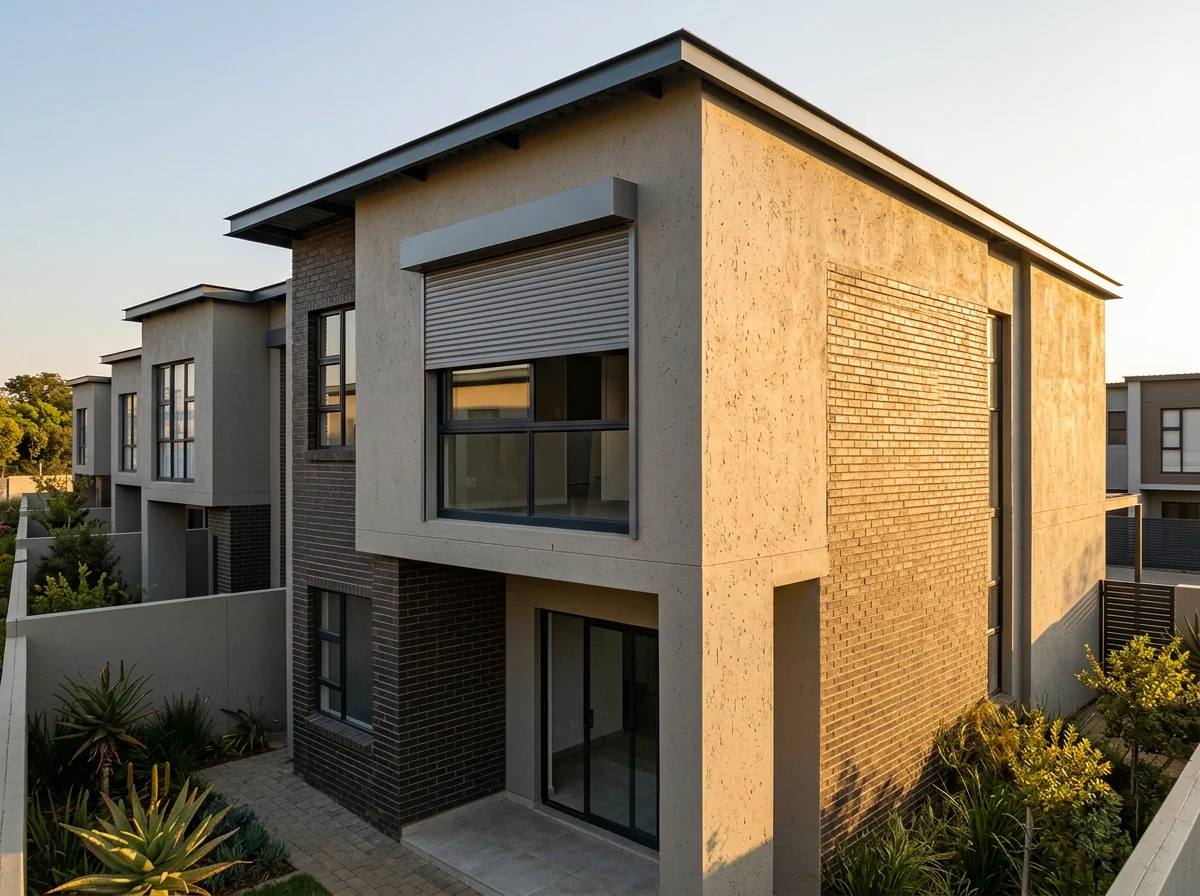
Most of Sunninghill's newer complexes were built for a look, not for shade. A thin roof edge reads as clean and contemporary; it also does almost nothing to interrupt the sun before it reaches the glass. In an older Bryanston homestead a deep eave carries most of the midday load on its own. Here there isn't one, so by mid-morning in summer the sun is on the window and it stays there — which is why this is the suburb where a roller shutter, fitted on the outside of the glass, earns its keep faster than almost anywhere else in the network.
The detail that changes on a thin-roofline house is where the headbox goes. On a homestead with a generous eave, the box can often tuck up under the existing overhang and more or less disappear. A Sunninghill unit has no overhang to hide it in, so the headbox becomes a visible, deliberate feature of the facade rather than an afterthought — which means the colour match to the window frame and fascia matters more here than on a house where the box is half-hidden already. We take the frame colour as the starting reference rather than a generic aluminium finish, because a shutter that reads as bolted-on is the one detail that makes an otherwise clean elevation look unfinished.
Operation is the second consequence of no overhang. On a house with deep eaves, only the low afternoon sun really gets past the shading the building already does, so the shutter comes down for one problem window at one time of day. On a Sunninghill wall with nothing shading it at all, the exposure runs longer — morning through to late afternoon on some elevations — so a sun sensor or timer isn't a nice extra here, it's doing daily work a manual strap genuinely can't keep up with across a full day rather than a single afternoon hour.
Storm timing matters on an exposed wall too. Gauteng's worst convective storms cluster in December and January and peak in the mid-to-late afternoon, the same stretch of day a west-facing shutter is often down for shade. A wind sensor that retracts the shutter automatically when gusts build is the honest answer — not because the slats are fragile, but because nobody wants to be phoning a neighbour to check on a shutter mid-storm while they're still at work. Most of Sunninghill's complexes also vet anything visible from outside, so the same specification sheet that settles the colour match usually goes to the body corporate before the shutter goes up; we hand you that sheet at the measure rather than after.
Worth saying plainly: a shading roller shutter is specified for sun, heat, glare and light control. It is not a security-rated shutter, and we would never let a customer assume otherwise — that's a different product on a different specification, available on request but never substituted quietly for this one.
Next step
Tell us what you're dealing with. One of our expert consultants will contact you shortly to arrange a free in-home measure with samples — no obligation.
Book my free measure Bryanston Blinds